Forklift pockets are a crucial element in the safe handling of containers. If you want to move a sea container, storage container or transport container with a forklift truck, you need to know the correct sizes of forklift pockets. Incorrect dimensions or unsuitable forklift trucks can quickly lead to instability, damage or safety risks. In this article, you will learn all about the sizes of forklift pockets, the relevant ISO standards, typical dimensions for 20-foot containers and important differences between different container types.
What are forklift pockets?
Forklift pockets – also known as forklift pockets – are specially reinforced openings in the lower section of a container. They enable containers to be safely picked up and transported with a forklift truck. They are particularly indispensable for empty or lightly loaded containers. The pockets are usually located in the bottom side rails and are designed so that the forks can be inserted safely (source: https://www.tis-gdv.de/tis/containe/arten/standard/standard-htm/).
What sizes are forklift pockets?
The sizes of forklift pockets are internationally standardized. The basis for this is ISO 1496:
- Width of the bag
- Height of the bag
- Distance between the pockets
- Maximum load capacity
The exact dimensions vary depending on the container size and container type.
Standard dimensions for 20-foot containers
Forklift pockets are fitted as standard on classic 20-foot containers. The pockets run parallel to the container’s central axis and enable empty containers to be lifted safely.
(Source: https://www.tis-gdv.de/tis/containe/arten/standard/standard-htm/)
Typical dimensions:
| Feature | Typical value |
| Pocket width | approx. 350 mm |
| Pocket height | approx. 115-120 mm |
| Distance center to center | approx. 2,050 mm |
| Suitable forklift tines | depending on ISO version |
The actual dimensions may vary slightly depending on the manufacturer.
Why do 40-foot containers usually not have forklift pockets?
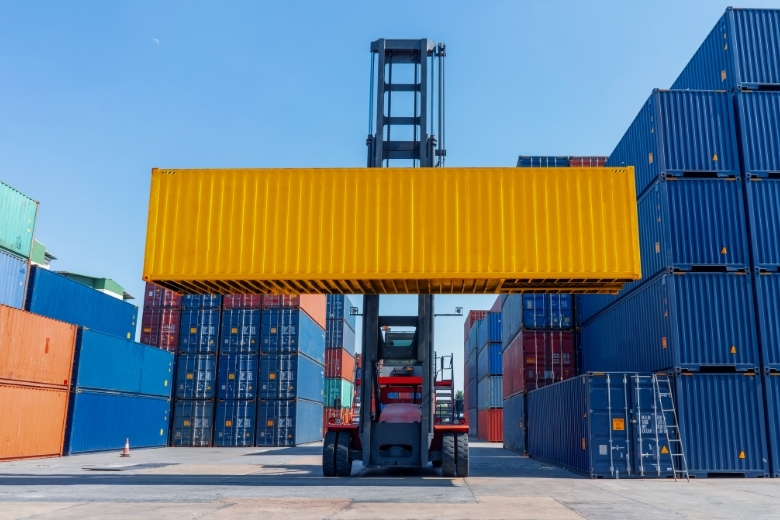
40-foot containers do not usually have forklift pockets. The reason lies in the statics and stability. Due to the great length, the center of gravity would be problematic when lifting with a forklift truck. In addition, the pockets are too close together, making it difficult to maintain balance.
(Source: https://www.tis-gdv.de/tis/containe/arten/standard/standard-htm/)
Instead, the following systems are usually used to transport such containers:
- Container chassis
- Reachstacker
- Gantry cranes
- Toplifter
Which ISO standards apply to forklift pockets?
The most important standards are
ISO 1496
This standard defines the technical requirements and dimensions for containers, including forklift pockets.
(Source: https://www.supralift.com/de/service/Gabelstapler-Enzyklopaedie/Gabelstaplertaschen.htm)
ISO 668
ISO 668 defines the standard dimensions of ISO containers and ensures that containers can be transported in a compatible manner worldwide.
(Source: https://de.wikipedia.org/wiki/ISO-Container)
Which containers have forklift pockets?
Not every container is equipped with forklift pockets. They are particularly common in:
- 10-foot containers
- 20-foot containers
- Storage containers
- Special containers
Many larger containers, however, do without this construction.
How important is the right truck size?
The size of the forklift pockets directly determines which forklift truck may be used. Forks that are too wide or too thick do not fit correctly in the pockets and increase the risk of accidents.
Important factors:
- Length of the forks
- Load capacity of the forklift truck
- Distance between the tines
- Load center
- Container weight
For loaded containers in particular, it is important to check whether the container is even approved for transportation by forklift truck.
(Source: https://www.tis-gdv.de/tis/containe/arten/standard/standard-htm/)
Conclusion: pay attention to the correct size of forklift pockets
The right sizes of forklift pockets are crucial for safe and efficient container transportation. Standardized forklift pockets are part of the basic equipment, especially for 20-foot containers. The dimensions are based on international ISO standards and must fit the forklift truck used exactly.
Anyone who wants to move or buy containers professionally should therefore always pay attention to:
- Standards
- Pocket dimensions
- Load capacity
- Container size
- Forklift compatibility
pay attention. In this way, damage, safety problems and unnecessary costs can be avoided.
Note: This article was created using AI-supported systems and editorially checked before publication.