What does TEU mean? – Origin and definition
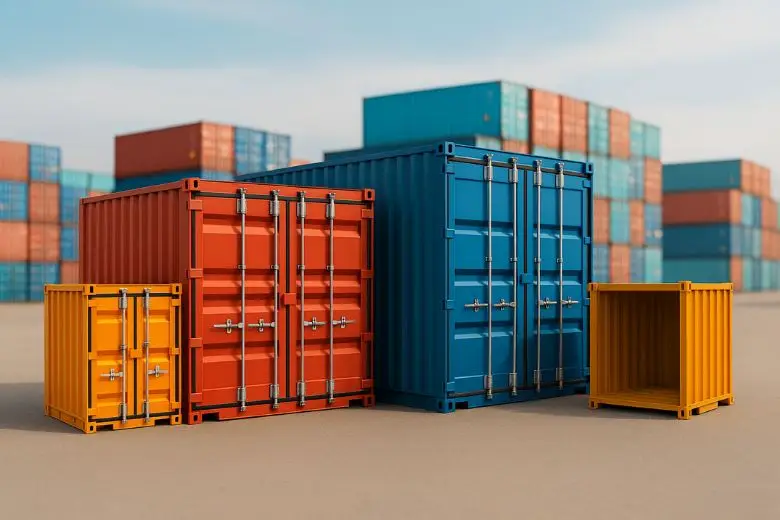
TEU stands for Twenty-foot Equivalent Unit, which translates as “20-foot equivalent unit”. 1 TEU corresponds to the dimensions of a standard sea container with a length of 20 feet, i.e. the classic 20-foot container. This standard size (20 feet corresponds to approx. 6.06 meters) serves as a reference unit. Larger containers can be converted into TEU: A 40-foot container corresponds to 2 TEU, as it is approximately twice as long. Accordingly, the term FEU(Forty-foot Equivalent Unit) is also used for a 40-foot container. Two 20-foot containers (2 × 1 TEU) therefore take up the same space as one 40-foot container (1 × FEU = 2 TEU).
The use of TEU as a unit of measurement came about with the standardization of containers in the second half of the 20th century. ISO containers were standardized in order to make the globally emerging container transport efficient – in other words, dimensions such as the length, width and corner fittings of containers were standardized worldwide. A 20-foot container has standardized external dimensions of around 6.06 m long × 2.44 m wide × 2.59 m high, while a 40-foot container is 12.19 m long with the same width. (Note: The standard height can vary – e.g. high-cube containers with a height of ~2.90 m – but the TEU calculation does not take height differences into account) This standardization made it possible to compare container sizes worldwide, and the TEU unit became the standard measure for specifying quantities and capacities.
The following overview of common container sizes and their TEU value helps to illustrate this:
| Container size | Outer length approx. | Corresponds to |
| 10-foot container (standard) | ~3,0 m | 0.5 TEU |
| 20-foot container (standard) | ~6,06 m | 1.0 TEU |
| 40-foot container (standard) | ~12,19 m | 2.0 TEU |
| 40-foot high cube container | ~12.19 m (higher) | 2.0 TEU (despite greater height) |
Note: There are also special sizes, such as 45-foot containers (~13.7 m long). In purely mathematical terms, these correspond to around 2.25 TEU, although in practice 45-foot containers are often also assumed to be 2 TEU for reasons of simplification. However, the 20 and 40-foot containers mentioned above are by far the most common sizes worldwide.
Example: How TEU is calculated (practical example)
The calculation of capacities in TEU is basically simple and is based on the number and size of containers. 1 TEU corresponds to a 20-foot container, 2 TEU to a 40-foot container. Basically, each container is converted to the 20-foot unit.
Example 1 – Ship information
A container ship with a capacity of 10,000 TEU can theoretically load 10,000 standard 20-foot containers. If larger 40-foot containers are loaded instead of 20-foot containers, 5,000 of them will fit (as each 40-foot container = 2 TEU). In reality, the cargo usually consists of a mixture of different container sizes – thanks to the TEU code, the total cargo can still be specified uniformly. For example, 3 × 20-foot containers = 3 TEU and 2 × 40-foot containers = 4 TEU – i.e. 7 TEU total cargo unit.
Example 2 – Company perspective
A company plans to transport goods in 50 40-foot containers. As each 40-foot container corresponds to 2 TEU, this results in a total freight volume of 100 TEU. This figure is important, for example, to book the required ship capacity with a shipping company or to obtain quotes for the shipment. Conversely, you could ask: How many containers do I need for 100 TEU of cargo? – Answer: either 100 standard containers (20 feet) or 50 large containers (40 feet), or any combination in between that adds up to 100 TEU.
Such simple conversions allow the TEU figure to be used for a quick rough calculation: everyone involved can immediately estimate what quantities are meant. This is particularly helpful when it comes to freight costs, ship utilization or storage capacities. Freight rates are often quoted in costs per TEU – for example, if X US dollars per TEU is mentioned on a certain route, you know that a 40-foot container costs twice as much (because 2 TEU). TEU is therefore also an economic indicator in the shipping and logistics industry.

CHS Container Group – Your partner for COntainer solutions
The CHS Container Group is an experienced provider when it comes to sea containers, storage containers and individual container solutions. With over 45 years of experience (founded in Bremen in 1978), CHS has established itself as a reliable partner in the container industry. Whatever your container requirements – CHS offers the right solution:
- Standard containers in all sizes: Whether 20-foot containers (1 TEU) or 40-foot containers (2 TEU) – at CHS you can obtain high-quality ISO containers for transportation and storage. Smaller 10-foot containers (0.5 TEU) or special container sizes are also available to meet your exact requirements.
- Sale and rental: You can buy containers from CHS – new or used – or rent them for temporary use. The flexible rental option is ideal if, for example, you need short-term storage space in the form of containers or want to use containers for specific projects.
- Special containers and modifications: CHS Container Group has its own workshop and the expertise to customize containers. Do you need a mobile office, a technical container or a special design? CHS builds special containers to measure – from sanitary containers and mobile workshops to complex modular container systems. So you don’t just get standard TEUs, but tailor-made space solutions based on containers.
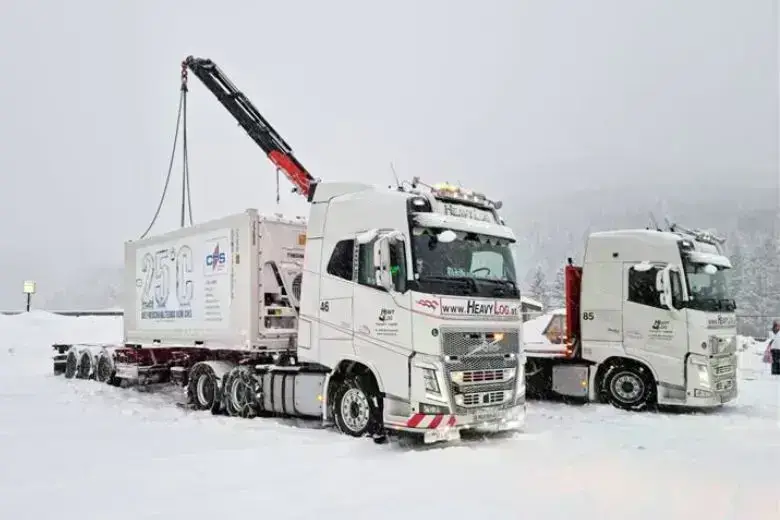
- Logistics and service: From consulting and delivery to on-site installation – CHS offers a full service. Thanks to a global network and logistical expertise, CHS brings containers to the desired location, organizes crane and transport services and takes care of permits, worldwide and around the clock. Customers benefit from smooth processes and support from real container professionals.
Trust and competence
Customer satisfaction is the top priority for the CHS Container Group. Numerous well-known customers – from industrial companies to shipping companies – have been relying on CHS for decades. The combination of container expertise (including all units of measurement such as TEU) and a broad range of services makes CHS an ideal partner for logistics decision-makers. So if you want to make your company fit for containerization, need advice on the optimum container size or want to quickly create additional container capacity, CHS is there for you. Our experts will be happy to advise you and find the best container solution for your needs.
Frequently asked questions – FAQ
What does TEU mean?
TEU stands for “Twenty-foot Equivalent Unit” and is the unit of measurement for a standard 20-foot container in container shipping. In other words: 1 TEU corresponds to a 20-foot container. This unit is used internationally to indicate the capacity of ships or the container throughput of ports. So when we talk about a certain number of TEUs, we mean the corresponding number of 20-foot containers (or equivalent container sizes).
What is a TEU container?
Strictly speaking, there is no such thing as an independent “TEU container” – the term refers to the size. It simply refers to a standard container with a length of 20 feet, as such a container is defined as 1 TEU. A 20-foot container is often colloquially referred to as a TEU container because it is the reference unit. In contrast, the 40-foot container (also known as FEU ) corresponds to 2 TEU. So when someone asks “Is that a TEU container?”, they usually mean: Is that a 20-foot standard container?
How many TEU fit on a ship?
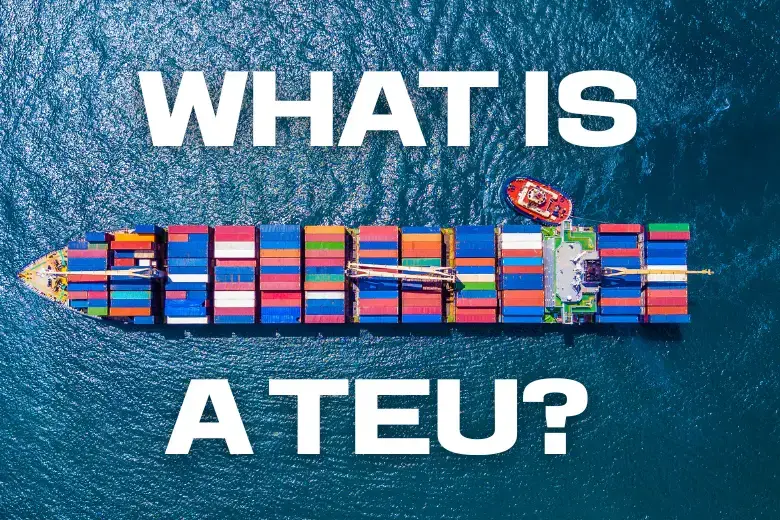
This depends entirely on the size of the container ship. Small feeder ships (feeder ships for shorter routes or smaller ports) often have capacities of a few hundred to a few thousand TEU (e.g. 500-2,000 TEU). Larger ocean-going vessels for intercontinental routes can load significantly more – modern freighters of the latest generation can reach 20,000 TEU and more. The world’s largest container ships currently have a capacity of around 24,000 TEU (as of the mid-2020s). By comparison, a ship with a capacity of 10,000 TEU can carry around 10,000 20-foot containers or 5,000 40-foot containers. For the very large mega-ships with ~24k TEU, the corresponding figure is ~12,000 40-foot containers. In practice, the payload is also dependent on weight and stowage plan, but the TEU figure provides a good guideline for comparing ship sizes.
How many TEU does the largest container ship in the world have?
The largest container ship in the world can currently transport around 24,000 TEU. Specifically, the record holders have a capacity of around 24,000 to 24,500 TEU. One example is the MSC Loreto (and its sister ship MSC Irina), which can each load around 24,346 TEU. These giants of the seas are approximately 400 meters long and 60 meters wide – their capacity roughly corresponds to 12,000 standard 40-foot containers. For comparison: 15 years ago, the largest ship was still around 15,000 TEU, which shows how rapidly capacities have grown. It remains to be seen whether even larger ships will come – however, the 24,000 TEU class already places enormous demands on ports and infrastructure.
Further questions about TEU or containers? If your question has not been answered here, please do not hesitate to contact us. The CHS Container Group is at your disposal with expertise in container dimensions, logistics and individual solutions.