
Using a shipping container for inland or maritime transport? If so, you need to obtain a specific safety document—the CSC certificate—before you can begin. In this guide, we explain the basics of CSC certification for containers, covering everything from technical requirements and testing criteria to options for renewal.
What is CSC Certification?
A CSC certificate is a safety certification confirming that your container meets all safety requirements set by the International Maritime Organization (IMO). Any container used for road or sea transport must possess a valid CSC certificate and a valid CSC plates before being transported.
CSC stands for “Convention for Safe Containers,” a set of regulations established and codified by the IMO in 1972. The convention defines the specifications a container must meet to ensure the safety of those working with them. By establishing a uniform global standard, the convention helps avoid regional differences, enabling the safe, intermodal transport of cargo worldwide.
Requirements for CSC certification
To obtain valid CSC certification, a container must undergo a thorough inspection by a qualified CSC inspector. To pass this inspection (also known as a “CSC survey”), the container must:
- be completely wind- and watertight, with no holes or points where light or water could leak when the container is closed
- be classified as structurally sound (cargo-worthy/seaworthy) based on a series of strength tests, confirming that the loaded container can be safely stacked for sea transport
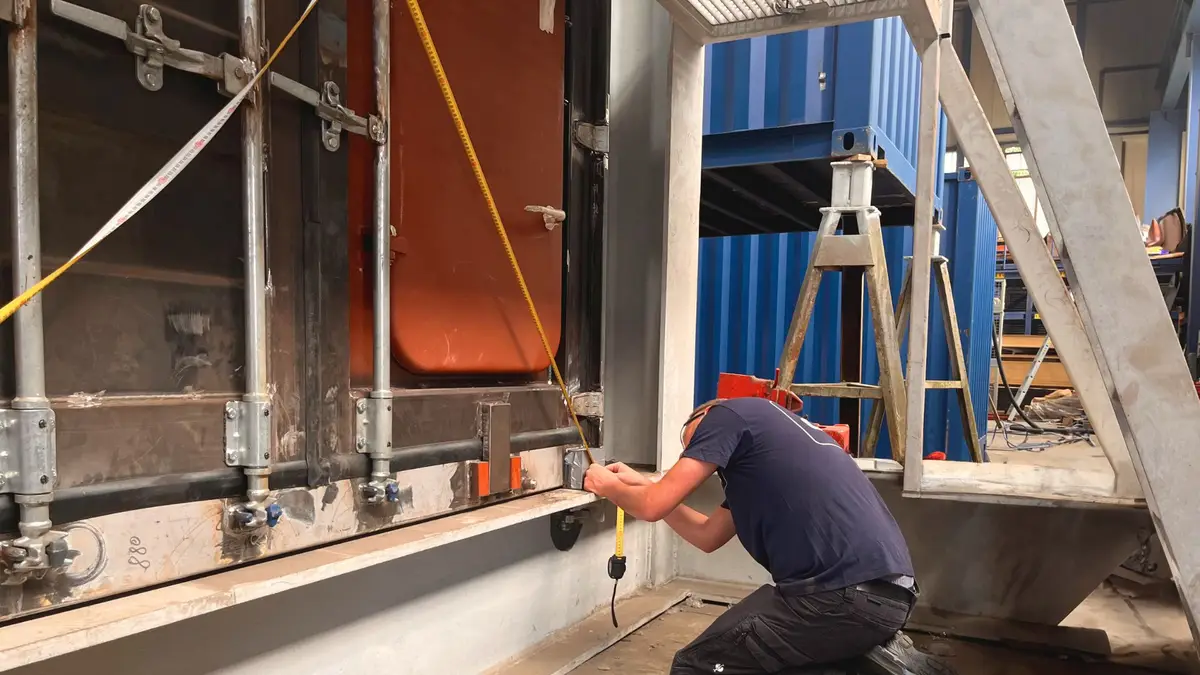
A container that passes the CSC certification process must then be fitted with CSC plates attesting to its safety for intermodal transport. A container that fails the inspection can still be used for storage but must not be used for intermodal transport.
What are CSC plates?
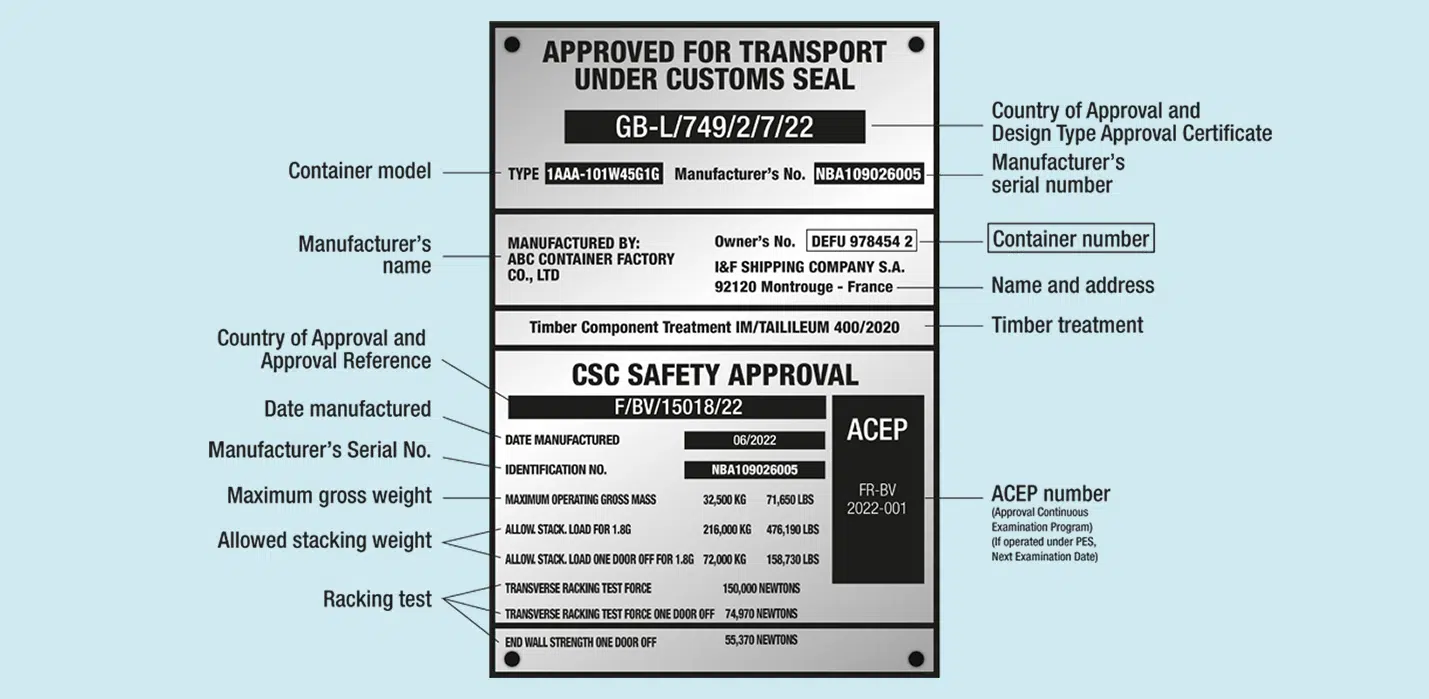
CSC plates, also known as “Safety Approval Plates,” are typically permanently fixed to the container at the time of manufacture. They are usually found on the outside of the container’s left-hand door. CSC plates contain important data about the container’s lifecycle, specifications, and certification, including:
- Manufacturer’s name and date of manufacture
- Unique identification and approval numbers
- Maximum gross weight
- Allowable stacking load
- Racking test load value
- Date of next inspection (if applicable)
- Number of the approved Continuous Examination Programme (if applicable)
To comply with the requirements of the Convention, CSC plates must be durable, corrosion-resistant, and fireproof, with high-contrast, stamped, or embossed lettering. The Bureau for International Containers(BIC) provides a detailed breakdown of the components of a CSC plate; an overview can be found below:
Intermodal terminals will not accept containers with invalid, incomplete, or missing CSC plates. It is the responsibility of the container owner or operator to ensure that the container has valid CSC plates prior to the departure date.
How to Get a CSC certification
To obtain CSC certification, you must work with an approved CSC surveyor. They will conduct a thorough examination of all container components, including a detailed inspection of the underside. Because this part of the inspection requires access underneath the container, most surveyors only visit select depots, repair facilities, or ports where containers can be safely lifted with a forklift or crane. If you do not have the ability to lift your container on your property, it is advisable to obtain CSC certification before delivery.
CHS Container Group conducts CSC inspections at our own workshop in Bremen. Our specially equipped facility has all the necessary resources and skilled personnel to carry out CSC inspections directly, reducing both the cost and turnaround time for your container’s certification.
Renewing CSC certifications
There are two ways to maintain a container’s required CSC certification: the Periodic Examination Scheme (PES) or the Approved Continuous Examination Programme (ACEP).
To participate in the Periodic Examination Scheme, your container must:
- undergo its first CSC inspection within five years of its date of manufacture.
- subsequently undergo re-inspection at intervals of no more than thirty months.
- clearly display the date of the next inspection (Next Examination Date, NED) on the CSC safety approval plate.
To participate in the Approved Continuous Examination Programme (ACEP), your container must:
- undergo a CSC inspection during every inspection at a repair facility.
- undergo a CSC inspection whenever a repair is carried out.
- clearly display the ACEP program number on the CSC safety approval plate.
Most major shipping lines and container leasing companies opt for the ACEP inspection scheme, as it is easier to track and implement on a large scale. Regardless of the chosen inspection scheme, the following applies: if a container sustains damage that compromises its structural integrity or safety, it must be taken out of service until it has been professionally repaired and recertified.
CSC Certification: Frequently Asked Questions
How much does CSC certification cost?
The cost of CSC certification depends on factors such as location, the condition of the container, and the scope of the required inspection. Please contact us directly for specific pricing.
Can I use a new (one-trip) container for intermodal transport?
Yes, provided the container has valid CSC certification. New or “one-trip” containers are units that are typically sold after carrying a single load of cargo in a shipment.
Can I use an IICL container for intermodal transport?
Yes, provided there is valid CSC certification. IICL containers—also known as multi-trip containers—are used units that are assessed and maintained according to the high standards of the Institute of International Container Lessors (IICL) to ensure an extended service life.
Can I use a “cargo-worthy” container for intermodal transport?
Yes, provided there is valid CSC certification. Cargo-worthy containers are used units that remain suitable for transporting freight.
Can I use a wind- and watertight container for intermodal transport?
No. The term “wind- and watertight” primarily describes the container’s condition regarding its seal integrity. It does not confirm that the container meets the structural requirements for international transport or possesses valid CSC certification. Consequently, such containers are frequently used for storage purposes.
Does CHS Container Group offer training on CSC certification?
Yes, CHS offers free training sessions on various container-related topics, including CSC certification. Please contact us for further information.