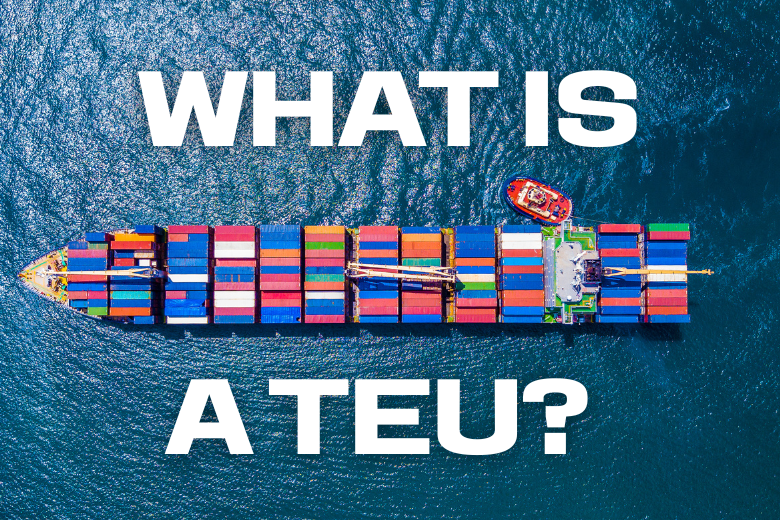
Getting ready to ship cargo overseas? While gathering freight rates, you’ve likely come across a unit of measurement that’s unique to maritime logistics: TEU. In this guide, we’ll walk through what a TEU is, how it’s calculated, and why it’s so important to the global shipping industry.
Key Takeaways
- TEU is a standard unit of measurement in shipping. It stands for Twenty-Foot Equivalent Unit.
- TEU is used to estimate how many ISO shipping containers a cargo ship can handle.
- A 20ft container = 1 TEU; a 40ft container = 2 TEUs.
- TEU is also used to measure port throughput, terminal capacity, vessel size, and freight rates.
What is a TEU?
A Twenty-Foot Equivalent Unit (TEU) is a standard unit of measurement in maritime logistics. It’s most commonly used to track how many shipping containers a cargo ship or shipping terminal has the capacity to handle. In an industry defined by complex dimensional tolerances, the logic of TEU is refreshingly simple: A 20-foot shipping container is equal to one TEU. A 40ft container is equal to two TEUs. A 10ft container is 0.5 TEUs, and so on.
Here’s a table of standard shipping container sizes paired with their TEU measurements.
| Container Size | External Dimensions | Number of TEUs |
|---|---|---|
| 10ft shipping container | 10’L x 8’W x 8’6”H | 0.5 TEUs |
| 20ft shipping container | 20’L x 8’W x 8’6”H | 1 TEU |
| 40ft shipping container | 40’L x 8’W x 8’6”H | 2 TEUs |
| 40ft high-cube shipping container | 40’L x 8’W x 9’6”H | 2 TEUs |
| 45ft shipping container | 45’L x 8’W x 8’6”H | 2.25 TEUs |
| 48ft shipping container | 48’L x 8’W x 8’6”H | 2.4 TEUs |
| 53ft shipping container | 53’L x 8’W x 8’6”H | 2.65 TEUs |
Unlike ISO container dimensions, which are precise physical measurements that demand accuracy within millimeters, TEU is used as a planning metric that approximates volume and capacity. For this reason, it’s not uncommon for TEU reporting to be a little looser. A 45ft container, for example, may be accurately reported as 2.25 TEUs, or simply rounded down to 2 TEUs.
Also of note: TEU doesn’t consider the height of a shipping container—just its length. A 20ft standard container and a 20ft high-cube container would therefore both be equal to 1 TEU.
| Container Length | Container Height | Measurement (TEU) |
|---|---|---|
| 20ft | Half-Height (4’3″) | 1 TEU |
| 20ft | Standard (8’6″) | 1 TEU |
| 20ft | High-Cube (9’6″) | 1 TEU |
Why is TEU Used to Determine Cargo Capacity?
Shipping containers vary in size and specialized components. They’re handled by freight forwarders, leasing companies, private shippers, and port authorities—each potentially using different terminology and regional measurement systems. Without a standard unit of measurement, consolidating these variables into a single stowage plan would be impractical for even a small feeder vessel, much less a megaship.
To effectively move over 80% of world trade volume by sea, cargo ship operators need a highly efficient—and resilient—method of calculating stowage. TEU provides exactly that: a universal unit of measurement that standardizes how we talk about cargo capacity.
How TEUs Are Used in Practice
Beyond measuring the capacity of cargo ships, the use of TEUs extends to freight costs, loading capacity, and port traffic.
- Storage capacity: Terminal operators use TEU to calculate how many containers can be comfortably processed and stored at their shipping terminal.
- Transport capacity: Cargo ship operators use TEU to determine how many shipping containers can be safely transported on a single vessel.
- Port traffic: Port authorities use TEU to measure their average container throughput, and use it to determine growth over time.
- Freight rates: Shipping lines and freight forwarders use TEU to determine how much it costs to ship a container of any size.
How Many TEUs Can Be Loaded on a Cargo Ship?
A cargo ship’s TEU capacity depends on its size/class. For example, small feeder ships—which travel shorter routes or service smaller ports—can typically carry up to 1,000 TEUs. Megaships or “Megamaxes”, on the other end of the scale, can transport in excess of 24,000 TEUs.
| Container Ship Size | Estimated TEU Capacity |
|---|---|
| Small Feeder | Up to 1,000 |
| Feeder | 1,000-2,000 |
| Panamax | 3,000-5,000 |
| Post-Panamax | 5,000-10,000 |
| Neopanamax | 10,000-14,500 |
| Ultra-Large Container Ship (ULCS) | 14,500-23,000 |
| Megamax | 23,000+ |
The TEU capacity of newer cargo vessels has grown by approximately 60% over the past decade. Fifteen years ago, the largest cargo ship had a capacity of around 15,000 TEU (or 15,000 20ft shipping containers). Today, the world’s largest container ships have a capacity of around 24,000 TEUs. Examples include the MSC Loreto and its sister ship, MSC Irina, each of which can carry an estimated 24,346 TEUs.
While even larger ship designs exist, their feasibility is limited by the world’s three major bottlenecks: the Panama Canal, the Suez Canal, and the Strait of Malacca. The largest conceptual ship design is the Malacca Max, which would carry about 27,000-30,000 TEUs while being able to safely pass the Strait of Malacca.
However, as vessels get larger, the number of ports able to service them shrinks. Common port equipment, such as Gantry cranes, aren’t able to service a ship of this configuration—and very few ports have the required channel depth to receive such a ship at all.
Which Container Ship Operator Has the Largest TEU Capacity?
As of 2025, the biggest container ship operator in the world is Mediterranean Shipping Company (MSC), with over 7.15 million owned and chartered TEUs in its fleet. Second is Maersk, with 4.6 million TEUs, followed closely by CMA CGM with 4.1 million TEUs.
Top 3 Shipping Lines by TEU Capacity (2026)
| Shipping Line | Capacity (TEU) |
|---|---|
| Mediterranean Shipping Company (MSC) | 7.15 million |
| Maersk | 4.6 million |
| CMA CGM | 4.1 million |
Which Port Has the Largest TEU Capacity?
The biggest container port in the world by TEU throughput is Shanghai, which processed over 55 million TEU in 2025—more than the top 5 U.S. ports combined.
Four of the world’s top five ports by TEU traffic are in China. This reflects its position as number one producer of consumer goods—in addition to being the largest manufacturer of shipping containers—in the world.
World’s Top Ports by TEU Traffic (2026)
| Port | 2025 Throughput (TEU) |
|---|---|
| Shanghai, China | 55.06 million |
| Singapore, Singapore | 44.5 million |
| Ningbo-Zhoushan, China | 43 million |
Los Angeles is the largest U.S. port by TEU throughput, with over 10 million TEUs processed in 2024. The Port of Houston, on the other hand, is the 5th largest port by TEU—but processes more tonnage than the top 5 ports combined, given the sheer volume of raw materials (like oil and gas) that pass through it.
Top U.S. Ports by TEU Throughput (2026)
| Port | 2024 Throughput (TEU) |
|---|---|
| Los Angeles, CA | 10.3 million |
| Long Beach, CA | 9.65 million |
| New York-New Jersey, NJ | 8.7 million |
| Savannah, GA | 5.5 million |
| Houston, TX | 4.14 million |
IS TEU The Only Unit of Measurement for Cargo Ships?
TEU isn’t the only unit of measurement used to calculate how many cargo containers a ship can safely handle. Forty-Foot Equivalent Unit (FEU), which is based on the measurements of a 40ft shipping container, is also common. Both are used, because 20ft and 40ft shipping containers are by far the most commonly used sizes used in international trade. One FEU is equal to two TEUs.
In addition to TEU and FEU, ocean carriers must account for weight restrictions. A ship’s cargo capacity isn’t just about fitting containers into available space—it also depends on total weight and how that weight is distributed. Regardless, TEU remains the most useful metric for comparing vessel sizes and capacity.
TEU: Frequently Asked Questions
What does TEU stand for?
TEU stands for Twenty-Foot Equivalent. It’s used to measure how many 20ft shipping containers can theoretically be loaded on a cargo ship.
What is 1 TEU equal to?
One TEU is equal to one 20ft shipping container. Two TEUs is equal to two 20ft shipping containers or one 40ft shipping container.
How many TEUs can fit on the largest container ship?
The world’s largest container ship, MSC’s Irina-class, can hold 24,346 TEUs.
How many TEUs is a 40ft container?
A 40ft container is equal to 2 TEUs. Height isn’t factored into TEU calculation, so a 40ft standard container and 40ft high-cube container are both equal to 2 TEUs.


