Buying a shipping container online isn’t quite like ordering something that arrives in a box. When your purchase is the box—and it weighs up to 8,000 pounds—there’s a bit more planning and coordination to consider.
In this guide, we’ll walk you through how shipping containers are delivered, the ballpark costs, and how to prepare your site for delivery.
Shipping Container Delivery Methods
The right delivery method depends on where you’re located, what size of container you’ve ordered, and whether you have any equipment on-site to lift it. Here’s a breakdown of the most common options used across our U.S. and European delivery networks.
Delivery in the U.S. and Canada
Tilt-Bed Delivery
Tilt-bed delivery is the standard shipping container delivery method for most retailers in North America. It’s the simplest method for all parties, as you don’t need to rent a crane or forklift to accept your delivery. The container arrives on a specialized tilt-bed trailer, pulled by a hotshot truck or standard truck cab. Then, the front of the bed is raised so the container slides safely to the ground as the driver slowly drives forward.
With this method, you’ll need to specify which end of the container you want facing out before it’s loaded—the driver won’t be able to reposition it once it’s been placed.
| Pros | Cons |
|---|---|
| No crane or forklift needed | Needs plenty of space for the truck and trailer to maneuver |
| Quick delivery (often under 30 minutes) | Slightly more expensive per mile than other methods |
Flat-Bed Delivery
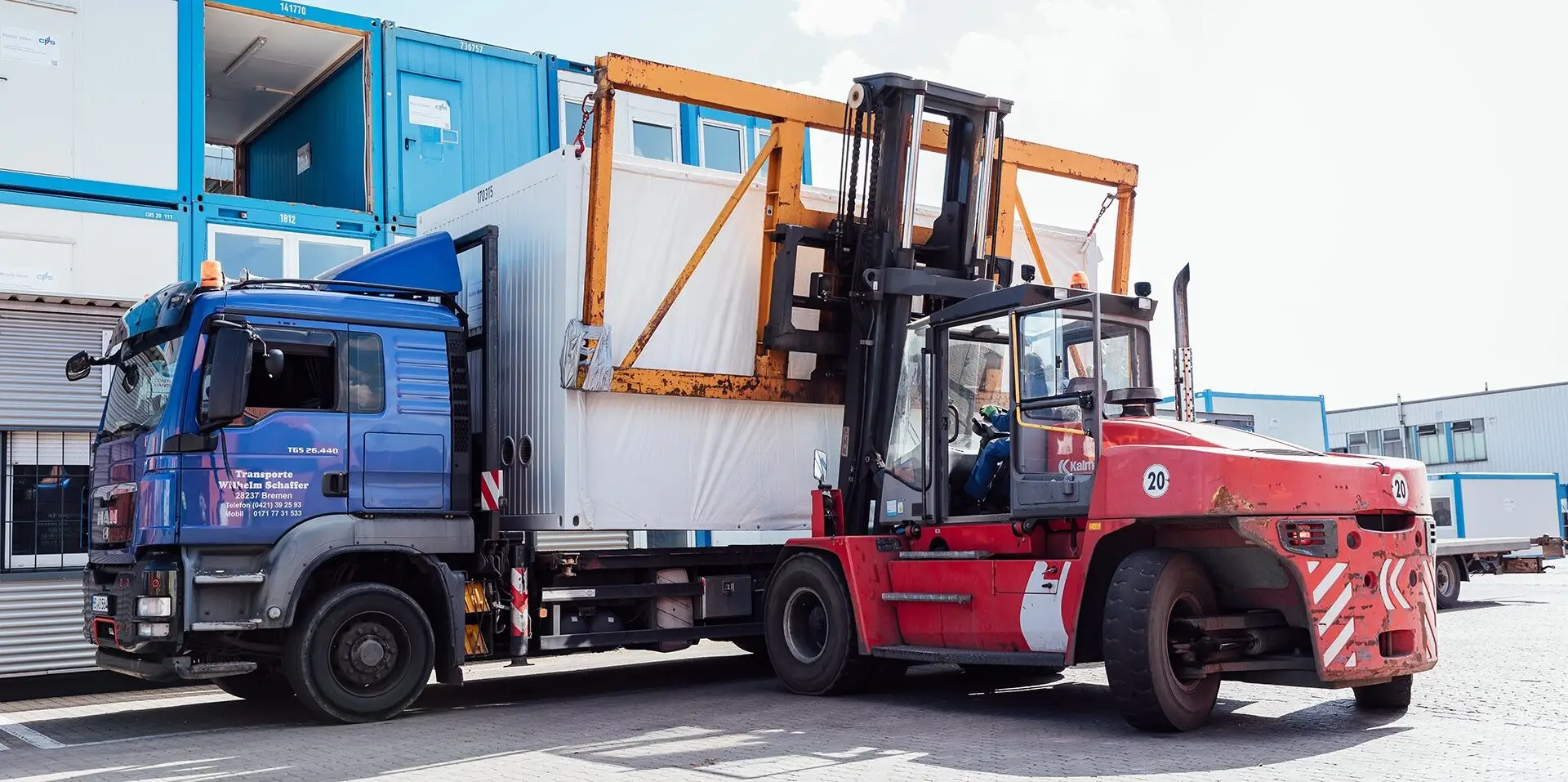
Flat-bed delivery works best for sites with lifting equipment already available, such as construction sites or industrial yards. For this delivery method, the container is delivered on a standard, flat trailer and must be lifted off by a crane or forklift at your location.
Flat-bed delivery can be slightly cheaper per mile than tilt-bed, as flat-bed trailers are more prevalent. However, you’ll also need to factor in equipment rental and operator costs if you don’t have the right gear on-site.
(Remember: If you plan to use a forklift to offload your container, double-check that your container comes with forklift pockets.)
| Pros | Cons |
|---|---|
| Often cheaper per mile than tilt-bed | Requires crane or forklift rental |
| More flexibility in where the container is placed | Driver won’t unload for you—you’re responsible for the lift |
Delivery in Germany & Other European Countries
Truck-Mounted Crane
For containers under 40ft, European deliveries often use truck-mounted cranes to facilitate shipping container deliveries. A truck-mounted crane is a crane built right onto the delivery vehicle—typically positioned at the front or back of the chassis—allowing the driver to lift and position the container with precision.
| Pros | Cons |
|---|---|
| Fast unloading | Not suitable in strong winds or unstable ground |
| Great for tight or residential spaces |
Side-Loader Delivery
For 40ft, 45ft, and 53ft shipping containers, a side-loader (also called a side-lifter) is often used. This truck has hydraulic arms that lift the container off the trailer and set it down next to the vehicle.
Depending on the side-loader’s configuration, unloading can happen on either the left or right-hand side of the chassis, giving some flexibility for tighter sites.
| Pros | Cons |
|---|---|
| Efficient and precise unloading | Needs adequate side clearance |
| No crane rental required | May cost slightly more than standard crane delivery |
Delivery Space and Site Requirements
Every shipping container delivery method has its own space and access requirements. Here’s a general guide.
| Region | Method | Length Clearance | Height Clearance | Width Clearance | Max Vehicle Weight |
|---|---|---|---|---|---|
| North America | Tilt-Bed | 100ft / 30.5m | 15ft / 4.5m | 12ft / 3.65m | Up to 20-25 tonnes |
| North America | Flat-Bed | 60ft / 18m | 4m / 13ft | 12ft / 3.65m | Up to 25 tonnes |
| Europe | Side-Lifter | 18.75 m / 61.5ft | 4m / 13ft | 7m / 23m | Up to 40 tonnes |
| Europe | Truck-Mounted Crane | 18.75m / 61.5ft | 4m / 13ft | 3.65m / 12ft | Up to 40 tonnes |
If your site can’t accommodate that kind of access, talk to your container sales representative. Alternatives—such the allocation of a smaller trailer, or even specialized repositioning equipment—may be available to facilitate your delivery.
Shipping Container Delivery Costs
Shipping container delivery costs depend on several factors, with distance, access conditions, road restrictions, and local driver availability being among them. Below, you’ll find rough estimates for budgeting purposes.
Delivery Costs in the U.S. and Canada
Deliveries are calculated based on heavy trucking routes and avoiding toll roads where possible. Containers can typically be delivered within a 300-mile radius of a depot, though there may be an additional charge for deliveries that cross state lines.
- Short-distance (local) tilt-bed delivery: around $400-$600
- Longer distance delivery (200-300 miles): $1,200-$1,550+
- Flat-bed transport: can be about $1 cheaper per mile (but requires extra equipment for unloading).
These figures are for budgeting purposes only. Refer to your quote for accurate delivery costs.
Delivery Costs in Germany & Other European Countries
Delivery costs are calculated based on heavy lorry routes and usually calculated on a per-kilometer basis. Containers can typically be delivered within a 400-kilometer radius of a depot, though extra fees may be incurred when ferry travel is required.
- Short-distance (local):
- Truck-mounted crane delivery: €370-€600
- Side-loader delivery: €380-€650
- Longer distance delivery (300-400km):
- Truck-mounted crane delivery: €1,200-€1,550+
- Side-loader delivery: €1,300-€1,700+
These figures are for budgeting purposes only. Refer to your quote for accurate delivery costs.
Preparing for Delivery
To make sure your shipping container delivery goes smoothly (and doesn’t incur dry run or re-delivery fees), it’s important to prepare your site ahead of time. Basic measures include:
Site Access
Make sure the road is suitable for a heavy truck and that there’s enough room for the driver to turn and back into position. Double-check for gates, tree branches, or overhead wires that might block the path anywhere between the road and your container’s destination.
Ground Preparation
Containers must sit on level, firm ground to function properly. Proper levelling helps avoid issues like door misalignment or structural stress, both of which can impede your ability to use the container later. If your site is soft or uneven, consider laying a foundation such as a gravel or concrete pad. If your container’s placement is temporary, consider using wooden blocks or railroad ties to keep it level.
Driver Communication
Send photos of your site and clear directions in advance. The more information you provide, the smoother delivery day will be. If the driver can’t safely access your property, you may still be charged for the trip—and the return run.
Shipping Container Deliveries: Frequently Asked Questions
Can I pick up a shipping container I buy online?
Yes, when you buy a shipping container online (or over the phone), you can usually choose between pickup and delivery. Just make sure you have the right-sized trailer to pick up your container, along with the right equipment to safely offload it at your destination.
How much does a shipping container delivery cost?
Shipping container delivery costs vary based on distance, local driver rates, and the delivery method selected. In the U.S., you can expect to pay anywhere between $400-$1,550+ for a tilt-bed delivery depending on your location, and about $1 less per mile for flat-bed delivery.
What kind of shipping container delivery methods are available?
Delivery methods vary by region. In the U.S. and Canada, you can choose from tilt-bed delivery, which doesn’t require any unloading equipment, and flat-bed delivery, which requires a crane or forklift to lift and position the container. In most European countries, you can choose from a truck-mounted crane for containers less than 40ft long, or a side-loader/side-lifter for containers 40ft or longer.
Does CHS Container Group USA offer shipping container delivery services?
Yes, when you buy shipping containers from CHS, we will arrange delivery to your location unless otherwise specified. If you have any questions about our shipping container delivery services, please ask your designated sales representative.